International Travel

English

Learn About Your Destination

Saint Lucia

Saint Lucia
Saint Lucia
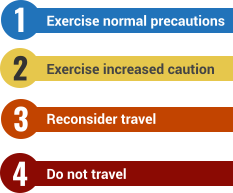
Exercise normal precautions in Saint Lucia.

The advisory level was increased to 2. The “Crime” indicator was added. Advisory summary was updated.

Exercise Increased Caution in Saint Lucia due to risk of crime.

Advisory summary

Violent crime can occur anywhere in Saint Lucia. U.S. citizens and other foreigners in Saint Lucia have been victims of armed robbery, assault, burglary, and rape.

In some cases, U.S. citizens have been killed.

Crime

  • Guests at tourist resorts have been victims of violent crimes.
  • Police response times are not as fast as in the United States.
  • Petty crime is common, especially in popular tourist locations. Stay aware of your surroundings.
  • Most crimes against foreigners are crimes of opportunity, like purse snatching and pickpocketing.
  • Tourists should beware of overcharging and scams in tourist areas. You may encounter aggressive vendors. Most sites have tourist police available to help in uncomfortable situations.

Hurricanes

Saint Lucia regularly experiences hurricanes. Review our information on Weather and Natural Disasters in Saint Lucia.

If you decide to travel to Saint Lucia:

  • Review the Country Security Report for the Eastern Caribbean.
  • Before you leave the United States for Saint Lucia, carefully check your luggage for any weapons or loose ammunition you may have forgotten and remove them. Review our information on Local Laws and Customs in Saint Lucia.
  • Review our information on Crime Abroad and for Victims of Crime.
  • Do not physically resist any robbery attempt.
  • Use caution when walking or driving at night.
  • Keep a low profile.
  • Stay aware of your surroundings.
  • Do not display signs of wealth, like expensive watches or jewelry.
  • Do not answer your door at your hotel or residence unless you know who it is.
  • Stay alert in tourist spots.
  • Stay alert when visiting banks or ATMs.
  • Whether you’re a first time or frequent traveler, use the International Travel Checklist.
  • We highly recommend that you buy travel insurance before you travel. Check with your travel insurance provider about evacuation assistance, medical insurance, and trip cancelation coverage.
... [READ MORE]

Embassy Messages

Alerts

Quick Facts

PASSPORT VALIDITY:


Valid for duration of stay in Saint Lucia

BLANK PASSPORT PAGES:


1 page required for entry stamp

TOURIST VISA REQUIRED:


No, but see entry-exit requirements below

VACCINATIONS:


None

CURRENCY RESTRICTIONS FOR ENTRY:


None

CURRENCY RESTRICTIONS FOR EXIT:


None

U.S. Embassy Bridgetown

Wildey Business Park
St. Michael BB 14006
Barbados, W.I.
Telephone:
+(246) 227-4000
Email: 

Passports and visa: U.S. citizens must have a U.S. passport that is valid for the duration of your stay. No visa is required if you have an onward or return ticket, confirmation of accommodation, and can produce evidence of your ability to maintain yourself.

NOTE: Generally, all U.S. citizens are required to present a valid U.S. passport when traveling to Saint Lucia, as well as proof of anticipated departure from the country. This includes travelers arriving by airplane and by private sea-going vessel. Those traveling to Saint Lucia on a cruise may use another Western Hemisphere Travel Initiative (WHTI) compliant document. However, we strongly recommend visitors obtain a passport before travel in case of an unforeseen emergency that requires a cruise passenger to disembark and return by air.

HIV/AIDS: The U.S. Department of State is unaware of any HIV/AIDS entry restrictions for visitors to or foreign residents of Saint Lucia.

Find information on dual nationalityprevention of international child abduction and customs regulations on our websites.

Crime: U.S. citizens are not specifically targeted for crime in the Eastern Caribbean islands. However, crimes of opportunity such as petty larceny, burglary, automobile break-ins; as well as incidents of violent crime, such as murder, sexual assault, robbery, shootings, and drug related crimes do occasionally occur. As you would in any major metropolitan area of the United States, use the below personal security measures while traveling:

  • Do not leave valuables unattended in public areas, on beaches, unsecured in hotel rooms, or in rental homes.
  • Avoid walking alone, especially at night, on beaches, and in isolated or poorly lit locations.
  • Go out in groups or with a companion and limit nighttime activities to established safe and reputable venues.
  • Use only clearly marked taxis and avoid rides with strangers.
  • Stick to well-lit and well-traveled routes.
  • Avoid displaying flashy jewelry, expensive electronics, and large amounts of cash.
  • Be aware of your surroundings at all times. If you see something suspicious or unusual contact local police to report immediately.
  • Use added caution when shopping in crowded areas, especially during the holiday season.
  • Use added caution when attending crowded events, celebrations, music festivals, etc.
  • Do not leave drinks unattended in public venues as this could create a potential vulnerability for the use of “date rape” drugs in furtherance of criminal activity.
  • Do not be predictable; vary your daily routes and schedules.
  • Do not engage in illegal activity.
  • For boaters: Be wary of unfamiliar persons or crafts approaching your boat, whether at anchor or at sea.

Firearms: Do not enter Saint Lucia with firearms or ammunition without prior express consent from the Saint Lucia government. Please contact the Embassy of Saint Lucia with questions regarding travel with firearms. 

Victims of Crime: Report crimes to the local police at 911 and contact the U.S. Embassy at (246) 227-4000.

Remember that local authorities are responsible for investigating and prosecuting the crime.

See our webpage on help for U.S. victims of crime overseas.

See the Department of State and the FBI pages for information on scams. 

We can:

  • help you find appropriate medical care
  • assist you in reporting a crime to the police
  • contact relatives or friends with your written consent
  • explain the local criminal justice process in general terms
  • provide a list of local attorneys
  • provide our information on victim’s compensation programs in the United States
  • provide an emergency loan for repatriation to the United States and/or limited medical support in cases of destitution
  • help you find accommodation and arrange flights home
  • replace a stolen or lost passport

Domestic Violence: U.S. citizen victims of domestic violence may contact the U.S. Embassy for assistance at (246) 227-4000.

Watersports Advisory: Carefully assess the potential risks of recreational water activities and consider your physical capabilities and skills. Never venture out alone, particularly at isolated beaches or far out to sea. Avoid entering the water above your waist if you have been drinking and always be mindful of jet ski and boat traffic in the area.

Tourism: The tourism industry is unevenly regulated, and safety inspections for equipment and facilities do not commonly occur. Hazardous areas/activities are not always identified with appropriate signage, and staff may not be trained or certified either by the host government or by recognized authorities in the field. In the event of an injury, hospitals are able provide urgent medical treatment, though very serious injuries often require medical evacuation. U.S. citizens are encouraged to purchase medical evacuation insurance

Criminal Penalties: You are subject to local laws. If you violate local laws, even unknowingly, you may be expelled, arrested, or imprisoned.

Penalties for possession, use, or trafficking in illegal drugs or firearms are severe. Convicted offenders can expect long jail sentences and heavy fines.

Furthermore, some laws are also prosecutable in the United States, regardless of local law. For examples, see our website on crimes against minors abroad and the Department of Justice website.

Arrest Notification: If you are arrested or detained, ask police or prison officials to notify the U.S. Embassy immediately. See our webpage for further information.

Firearms: Do not enter Saint Lucia with firearms or ammunition without prior express consent from the Saint Lucia government. Please contact the Embassy of Saint Lucia with questions regarding travel with firearms. 

Faith-Based Travelers: See the following webpages for details:

LGB Travelers: Consensual same-sex sexual activity is illegal, with penalties up to 10 years in prison. No legislation protects persons from discrimination based on sexual orientation.

See our LGB Travel Information page and section 6 of our Human Rights report for further details.

Travelers Who Require Accessibility Assistance: Access to buildings, pedestrian paths, and transportation is extremely difficult for persons with mobility issues. Sidewalks (if they exist) are very uneven and will only occasionally have ramps at intersections. Pedestrian crossings are also very infrequent and can be poorly marked. Buses and taxis do not have special accommodations.

Students: See our Students Abroad page and FBI travel tips.

Women Travelers: See our travel tips for Women Travelers.

Medical facilities in Saint Lucia do not meet U.S. standards. Doctors and hospitals often expect immediate cash payment for health services.

We do not pay medical bills

Be aware that U.S. Medicare and Medicaid do not apply overseas.

Medical Insurance

Make sure your health insurance plan provides coverage overseas. . Most care providers overseas only accept cash payments. We strongly recommend supplemental insurance to cover medical evacuation.

See our webpage for more information on insurance coverage overseas.

If traveling with prescription medication, check with the government of St. Lucia to ensure the medication is legal in St. Lucia. Always carry your prescription medication in original packaging with your doctor’s prescription. 

The following diseases are present:

  • Chikungunya
  • Dengue
  • Zika

Vaccinations

Be up-to-date on all vaccinations recommended by the U.S. Centers for Disease Control and Prevention.

Air Quality

Air pollution can be a significant problem in many destinations overseas.

  • Check NASA’s Air Quality Forecast, which uses Artificial Intelligence (AI), historical data, and global pollution modeling to generate a three-day forecast of expected air quality in Saint Lucia. 
  • For information about common air pollutants, check the CDC’s Air Quality page
  • For information about the U.S. Air Quality Index and health guidance, check out the EPA’s AirNow
  • For general health information, visit the “Your Health Abroad” page.

Further health information

Road Conditions and Safety: Be extremely careful when driving, riding in a vehicle, or crossing roads on foot. Major roads are in average to poor condition, and you may encounter wandering animals and slow moving heavy equipment. Drivers often stop in the middle of the roadway without warning. Always maintain a safe distance from the vehicle in front of you and watch for signs of sudden braking. Automobiles may lack working safety and signaling devices.

See our Road Safety page for more information.

Traffic Laws: Driving is on the left-hand side of the road. There is relatively little police enforcement of traffic regulations. A local temporary driver's license is required. These can be purchased at all car rental offices and from the Transportation Office in Gros Islet.

Public Transportation: Public transportation consists of mini-buses and taxis.

See our Road Safety page for more information.

Aviation Safety Oversight: The U.S. Federal Aviation Administration (FAA) has assessed the Eastern Caribbean Civil Aviation Authority, which is responsible for regulating aviation safety and security for the government of Saint Lucia, as not being in compliance with International Civil Aviation Organization (ICAO) aviation safety standards for oversight of Saint Lucia’s air carrier operations. Further information may be found on the FAA’s safety assessment page.

Maritime Travel: Information may be posted to the U.S. Coast Guard homeport website, and the NGA broadcast warnings

For additional travel information

  • Enroll in the Smart Traveler Enrollment Program (STEP) to receive security messages and make it easier to locate you in an emergency.
  • Call us in Washington, D.C. at 1-888-407-4747 (toll-free in the United States and Canada) or 1-202-501-4444 (from all other countries) from 8:00 a.m. to 8:00 p.m., Eastern Standard Time, Monday through Friday (except U.S. federal holidays).
  • Follow us on X (formerly Twitter), Facebook, and Instagram.
  • See traveling safely abroad for useful travel tips.

International Parental Child Abduction

Review information about International Parental Child Abduction in Saint Lucia.  For additional IPCA-related information, please see the International Child Abduction Prevention and Return Act (ICAPRA) report.


Last Updated: January 21, 2025

Travel Advisory Levels

Assistance for U.S. Citizens

U.S. Embassy Bridgetown
Wildey Business Park
Wildey
St. Michael BB 14006
Barbados, W.I.
Telephone
+(246) 227-4399
Emergency
+(246) 227-4000
Fax
+(246) 431-0179

Saint Lucia Map